
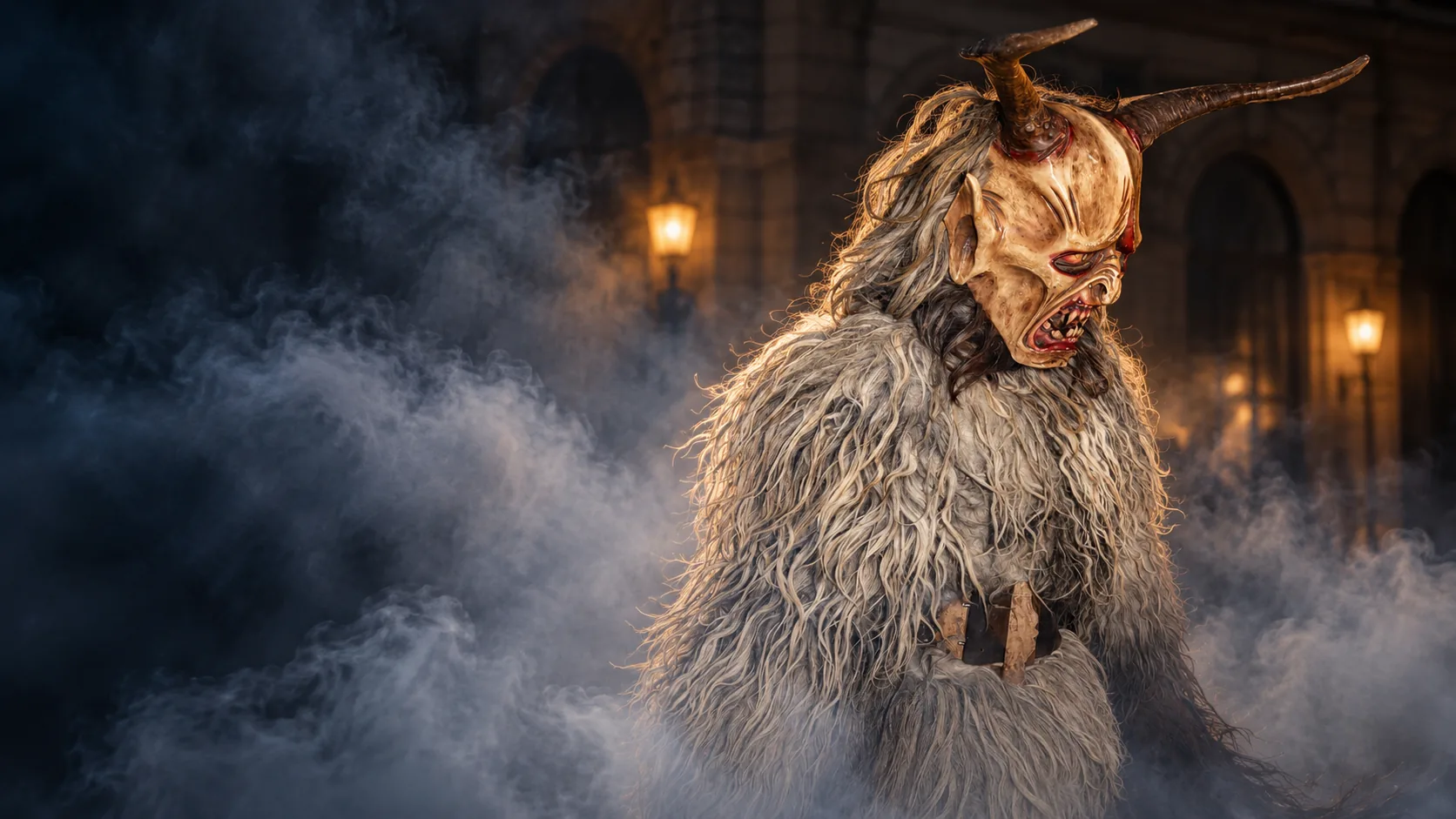
The Rauhnächte ("rough nights") are among the best-known winter themes in the Bavarian Forest. Their mix of the Christian festive calendar, the farming year, folk belief and modern staging makes them fascinating – and in need of explanation. So anyone attending a Rauhnacht event is not simply experiencing an unchanged tradition from ancient times, but a living regional culture in which documented customs, traditional stories and present-day celebrations exist side by side.
This article is part of our series Legends, myths & stories from the Bavarian Forest, which also covers the White Lady, the Wild Hunt and mystical forest places.
What are the Rauhnächte?
Rauhnächte or Raunächte are the nights around the turn of the year that held special significance in Central European folk belief. There is often talk of twelve nights. The common count begins with the night of 24 to 25 December and ends with the night of 5 to 6 January; there are, however, regional variations, for example starting on St Thomas's night around 21 December.
The origin of the name is not clear either. One interpretation links it to the smudging (Räuchern) of house and stable. Another traces it back to an older word for "hairy" or "furry", and thus to fur-clad masked figures. The honest answer is therefore not a single origin story, but that both interpretations exist side by side.
Between Christmas and Epiphany
This period lies between closely spaced holidays: Christmas, New Year and Epiphany. For the rural population, winter was also a quieter phase of the working year. In this threshold time, religious blessings, rules for house and farm, and stories of a temporarily permeable border with the spirit world came together.
Historical and folklore sources document individual practices such as smudging and various oracles or bans on work. Many interpretations popular today – for example a fully worked-out system in which each night reliably predicts a month of the coming year – are, by contrast, modern or were systematised later. They can be part of personal rituals today, but should not be presented as an ancient tradition that is the same everywhere.
Customs in the Bavarian Forest
Smudging and blessings for house and farm
Smudging living rooms, stables and farmyards is one of the best-documented customs. Incense, frankincense or locally available herbs were combined with prayers and ideas of blessing. The Massing open-air museum shows that, for example, vessels with embers and herbs were used for this. Purpose and practice differed by place, time and household.
Bells, noise and masks
Noise, large bells, whip-cracking (Goaslschnalzen) and masked figures are part of many Rauhnacht and Perchten events today. In the Bavarian Forest, local figures and groups appear whose names and masks can be closely tied to their village. In the stories, the loud commotion is often interpreted as warding off evil. At today's events, it is also a deliberately staged public performance.
Oracles and traditions
Weather lore, signs of the future and tales of the "Wild Hunt" belong to traditional folk belief. Such motifs describe the ideas of earlier generations; they are not verifiable facts. Anyone who writes down wishes, smudges or pours wax today is usually practising a modern, personal form of reflection – not automatically a historically uniform custom.
Rauhnächte and Perchten – what is the difference?
Rauhnächte refers first of all to the special period and the customs and beliefs associated with it. Perchten are masked figures that appear mainly in Alpine and southern German winter customs. Not every Rauhnacht includes a Perchten run, and not every masked group today can be classified as an unchanged historical tradition.
It is just as important to distinguish them from the Krampus: Krampus figures traditionally belong to Advent and the time around St Nicholas' Day. At modern events, however, imagery and groups are sometimes combined. For guests, the organiser's specific description is more reliable than a blanket label.
Rauhnacht events around Freyung
For this article, we checked official annual programmes, municipal websites and the events calendar of the Tourismusverband Ostbayern. Only events that had been reliably published with date, place and time on 6 October 2026 are included.
Long museum night on customs and superstition in the Rauhnächte
- Place: Finsterau open-air museum, Museumsstraße 51, 94151 Finsterau
- Date and time: Saturday, 24 October 2026, 6–9 pm
- Organiser: Zweckverband Niederbayerische Freilichtmuseen with the partners named in the annual programme
- Admission / registration: the annual programme does not list separate registration for this event; please check current information directly with the museum.
- Source: official 2026 annual programme of the Finsterau open-air museum
Traditional Waldkirchen Rauhnacht
- Place: Marktplatz, 94065 Waldkirchen
- Date and time: Tuesday, 5 January 2027; 8–10 pm, with a supporting programme from 6:45 pm according to the announcement
- Organiser / participants: Waldkirchner Rauhnacht with the local groups named in the announcement; the town of Waldkirchen refers to the association's website.
- Admission / registration: not listed as required on the event page we checked; please check the organiser's current information before you travel.
- Source: Bavarian Forest events calendar / Tourismusverband Ostbayern and the town of Waldkirchen
Deliberately not listed as fixed dates: the regional overview also mentions the Koishüttler Lousnacht in Neuschönau and the Rauhnacht spectacle in Altreichenau. However, at the time of checking, complete and directly confirmed information on time, organiser and participation for 2027 was not available for both events. That is why they are not listed here as firm recommendations.
Experience the Rauhnächte around Freyung
From Freyung, cultural sites and events in the south-eastern Bavarian Forest fit easily into a winter day. For historical everyday culture, the Finsterau open-air museum is a particularly fitting choice; more regional cultural destinations are collected on our page Museums and culture around Freyung. In Freyung itself, it is worth checking the official events calendar before planning, as short-notice programmes and changes should not be replaced by old event lists.
Anyone attending an event mainly experiences a present-day public form of the custom. The handcrafted masks, local figures and the groups' explanations convey regional identity; fire, bells and drama also turn it into a winter spectacle.
Combine with winter days on the Geyersberg
A Rauhnacht combines well with quiet days on the Geyersberg. Our winter guide to Freyung covers skiing, ice skating and alternatives when there is little snow. For outdoor exercise, see our article on winter hiking and cross-country skiing around Freyung; in rain, thaw or stormy conditions, the rainy-day guide has suitable alternatives.
After a loud evening of masks and bells, the chalet offers a calm counterbalance: a private sauna, hot tub and time with no programme. If you would like to travel between Christmas and Epiphany, you can combine the Rauhnächte with a winter getaway in the chalet.
Practical tips
- Check on the day of the event: weather, safety requirements or organisational reasons can change programmes.
- Plan your journey: for large events, read the organiser's parking and public transport information in good time.
- Warmth and grip: winter clothing and shoes with good tread are sensible even in town.
- Mind the noise: bells, bangers, music and whip-cracking can be very loud. Ear protection can be helpful, especially for children.
- Consider the masks from a child's point of view: dark costumes, fire and sudden movements can frighten younger children. Keeping your distance and having an easy place to retreat to helps.
- Respect barriers: do not enter fire areas or the groups' routes; follow the instructions of organisers and emergency services.
Sources and currency
Research and event information as of 6 October 2026. Please check event details with the organiser again immediately before you travel.
- Haus der Bayerischen Geschichte: Perchten in the twelve Rauhnächte (German)
- Massing and Finsterau open-air museums: historical smudging traditions (German)
- Tourismusverband Ostbayern: Rauhnächte, Perchten and events (German)
- Finsterau open-air museum: 2026 programme (German)
- Tourismusverband Ostbayern: traditional Waldkirchen Rauhnacht 2027 (German)
- Town of Waldkirchen: the Rauhnacht as a local cultural event (German)
- Municipality of Neuschönau: Lousnacht and local association (German)